

 616281181



Researchers from several Copenhagen university centers, in collaboration with the Sports Groin Pain Center of the Aspetar Clinic in Qatar, examined what effect the use of an 8-week training program involving progressive performance of a single, simple exercise called Copenhagen Adduction (CA) has on thigh adductor strength and endurance. This exercise was chosen for its simplicity and ease of implementation in a real-world setting, as it can be performed on the field without the need for any instruments, but only with the help of a partner, and partners can take turns practicing.
The exerciser assumes a supine position lying sideways on his forearm, with his partner supporting his upper leg from behind near the ankle and, with his other hand, below the knee. The exerciser, keeping his torso horizontal and legs extended in a V-shape, performs a 3-second adduction movement of the lower leg to the upper leg supported by the partner, followed by a 3-second eccentric movement of lowering the leg until it touches the ground. Partners should be matched in pairs so that they are as similar as possible in height and weight.
In a separate study, the electromyographically measured activation of the upper leg's long thigh adductor muscle during this exercise was found to be 108% of maximal volitional isometric tension (MVIC), while that of the lower leg was 69%.
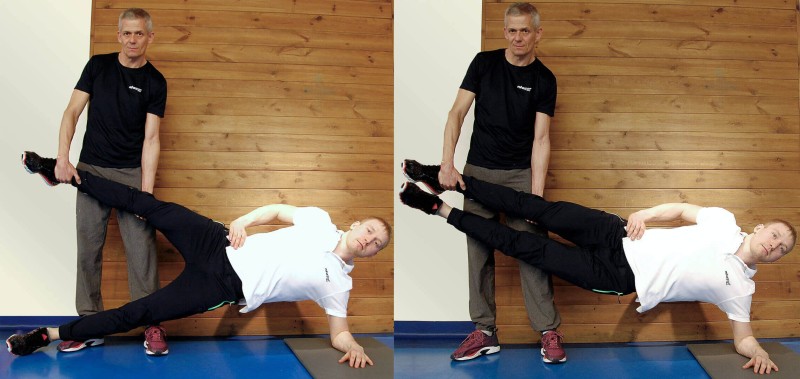
The experiment involved 20 U19 soccer players from two Danish second division clubs. The players were measured for eccentric hip adductor strength and trunk muscle strength in lateral recumbency, as well as eccentric hip adductor strength to calculate the adductor to adductor strength ratio. The athletes were then divided into two groups: one group performed two sessions per week of CA exercise for 8 weeks with progressively higher numbers of series (2, then 3) and repetitions (starting with 6 and ending with 15 on each side).
The results of the training are shown in the following diagrams:
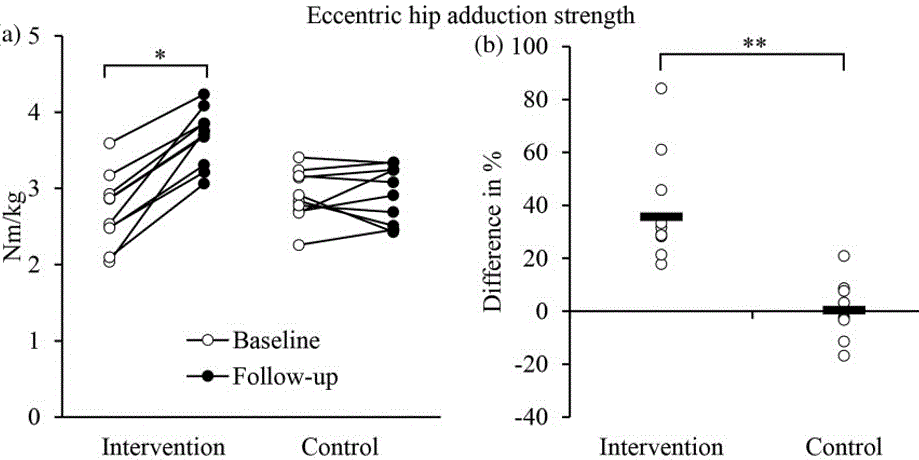
Figure 1 (Fig. 3).
(a) Eccentric hip adductor strength (EHAD) for each participant in the intervention and control groups before and after the intervention [Nm/kg].
(b) Percent difference in eccentric hip adductor strength for each participant in the intervention and control groups. Black dashes indicate mean difference.
* and ** - Statistically significant difference: * - within group, ** - between groups.
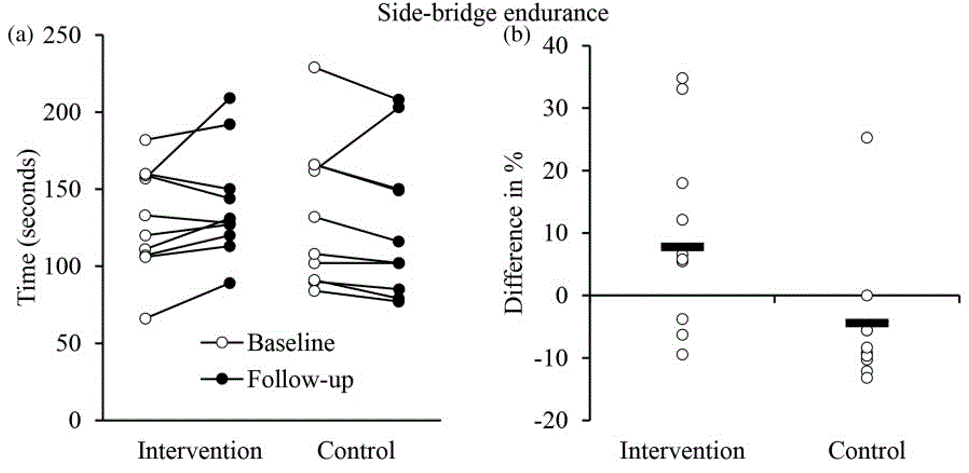
Figure 2 (Fig. 5).
(a) Strength (time) in forearm support lying sideways in the intervention and control groups [s] for each subject in the intervention and control groups before and after the intervention.
(b) Percentage difference in strength in forearm support lying sideways for each participant in the intervention and control groups. Black dashes indicate mean difference.
The 8-week training consisting of only one exercise increased the eccentric strength of the thigh adductors by an average of 36% in the intervention group, the thigh abductors by an average of 20%, and thus increased the adductor/abductor strength ratio by 12.3%. In the control group, these parameters remained unchanged.
Strength (time) in forearm support lying sideways in the intervention group increased by 7.8%, and decreased by 4.4% in the control group.
The results prove that it is possible to quickly and significantly increase the strength of the thigh adductors by performing a simple exercise that is easy to implement in training practice, although the direct effect of such muscle strengthening on the incidence of injury to these muscles has not been studied. However, based on the results of a similar study for the muscles of the posterior group of the thigh, in which strengthening this group with a single exercise (Nordic Hamstring) was proven to significantly reduce the risk of injury to this muscle group, the researchers believe that a similar effect can be expected.
Biomechanical analysis of the action of the adductor longus muscle when kicking, with maximum force, a ball from a run-up with the inner part of the foot reveals that maximum activation coincides with the greatest visitation of the thigh, indicating that this type of kick poses an increased risk of its injury. Research confirms that this type of ball kick is indeed the most common mechanism of acute groin injury in soccer.
CA exercise is best performed after proper training, during the fatigue phase, which can further counteract the effects of fatigue on injuries, especially common at the end of a match. It is also recommended to perform it regularly not only during the preparation period, but also throughout the year.
It is worth mentioning that during this 8-week program, none of the exercising players complained of any negative consequences caused by the exercise (except, of course, the typical post-workout muscle soreness).
Source:
“Large eccentric strength increase using the Copenhagen Adduction exercise in football: A randomized controlled trial.” Ishøi L, Sørensen CN, Kaae NM, Jørgensen LB, Hölmich P, Serner A4. Scand J Med Sci Sports. 2016 Nov;26(11):1334-1342. doi: 10.1111/sms.12585