

 616281181



Researchers from two university centers in Zurich, Switzerland, investigated whether such individuals really exist and whether the lack of response to training loads simply depends on the dose size of those loads.
To this end, a simple and clever research protocol was constructed. The 78 healthy adults were divided into 5 groups according to their own preferences, each of which respectively performed 1, 2, 3, 4 or 5 1-hour varied (fixed, intensity, as well as interval) endurance workouts on a bicycle ergometer per week, for 6 consecutive weeks.
Non-response was defined as no change in cardiorespiratory fitness as determined by maximum power in a graded-load test with typical measurement error (±4%). Subjects who did not respond to training performed another 6-week block, in which they were added two additional training sessions per week, respectively (regardless of how many times per week they trained in the first block). Before and after each training block, subjects also had their maximal oxygen uptake (VO2max), hematological parameters recorded, and muscle biopsies taken to determine the density of mitochondria in the cells of the vastus lateralis muscle of the thigh.
After the first training block, the number of non-responders was as follows: 1 training a week - 69%, 2 - 40%, 3 - 29%, while in the groups training 4 and 5 times a week there were no such subjects. After the second block, non-response to training was eliminated in all study participants.

Fig. 1. Percentage individual changes in maximum power (Wmax) after the first training block in each group. Typical measurement error indicated by shaded area (values in this area were considered to be unresponsive to training).
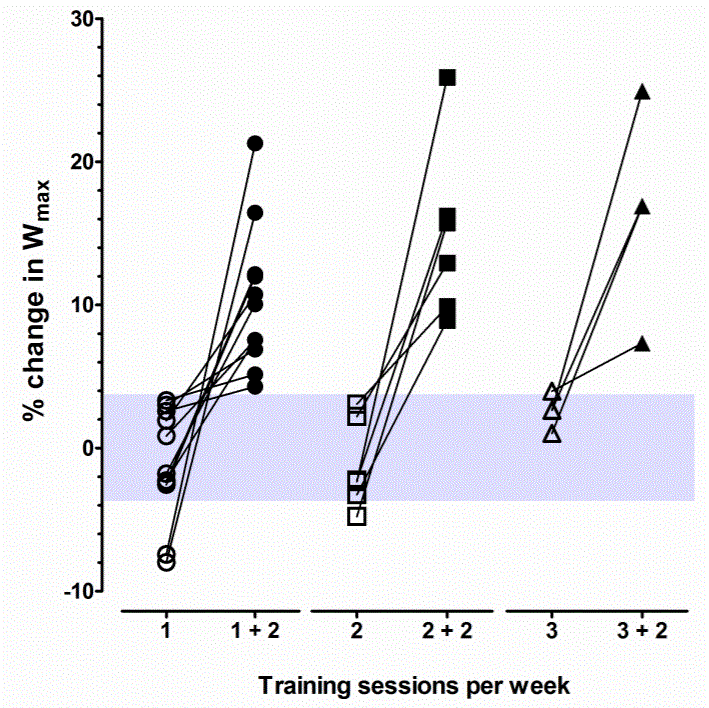
Fig. 2: Percentage individual changes in maximal power (Wmax) after the second training block for those considered not responding to training in each group after the first block. Typical measurement error indicated by the shaded area (values in this area were considered non-responsive to training). No non-response to training after the second block was found in any of the subjects.
In conclusion, it was emphasized that there is no such phenomenon as a lack of response to performance training, only the fact that some individuals simply require an increase in training stimulus to achieve the same training effects.
Another conclusion was that the increase in cardiorespiratory fitness is mainly due to hematological changes associated with an increase in oxygen transport capacity (mainly an increase in total hemoglobin mass), which in turn affects the maximum oxygen uptake capacity and consequently an increase in maximal power in endurance efforts.
Source:
„Refuting the myth of non-response to exercise training: ‚non-responders’ do respond to higher dose of training.” Montero D, et al. J Physiol. 2017 Jan 30. doi: 10.1113/JP273480