
 616281181



The interesting thing about the experiment conducted by the Italian-American team of researchers on ultramarathoners is the fact that their running training is supplemented by an easy-to-implement strength-exercise-plyometric training program performed only with the body's own resistance and possible to implement at home.
Running ultramarathons is not a professionally practiced sport, and the athletes who practice it are generally not too keen on regular training in gyms - both for “philosophical” and, often, logistical reasons. The case is similar with the rest of the amateurs competing in marathon running, which is why, according to the researchers, strength training that can be done at home is more likely to be done on a regular basis.
The experiment involved 25 advanced ultramarathoners, none of whom performed regular strength training. After being randomly divided into two groups, control and experimental, the latter group, in addition to their regular running training, completed a 12-week training regimen that consisted of simple strength, plyometric and explosive exercises performed for about 30 minutes every other day, except on days following very long or intense running workouts and competitions. In contrast, the control group continued their regular running training.
The training program was set up to allow, previously non-strength-trained runners, an initial period of adaptation, in which training volume and intensity were gradually increased, and exercises were introduced in a specific order: central stabilization and running technique exercises, strength exercises, explosive exercises and plyometric exercises. Examples of the exercises used included various types of supports, toe and heel marching, half Bulgarian squats, lunges, high step climbs, skips, jumping jacks, drop jumps, including squats performed on unstable surfaces, which was found to be useful for field runners.
The athletes in the experimental group performed 5-8 exercises 3 times a week in 1 to 3 series with 15 repetitions in each series without a break or with short (<30 s.) breaks between exercises. As mentioned above, all exercises were performed without additional external loads.
Before and after the intervention, the athletes of both groups were measured for the energetic cost of running at the four speeds most typical of ultradistance running, as well as the kinematics of running. The main conclusion was that 12 weeks of “home” strength-exercise-plyometric training without external loads reduced the energetic cost of running (improved running economy) by an average of about 4.3% at submaximal speeds, and that the increased time of foot contact with the ground during running, as well as an increase in maximal muscle strength, could most likely be responsible for this. It was calculated that a 4% reduction in the energy cost of running, could lead to a reduction of about 17 minutes in running time over 100 km (with a total running time of about 9 hours). Therefore, the authors suggest introducing simple strength-exercise-plyometric training into the training of long-distance runners at a rate of 2-3 units per week.
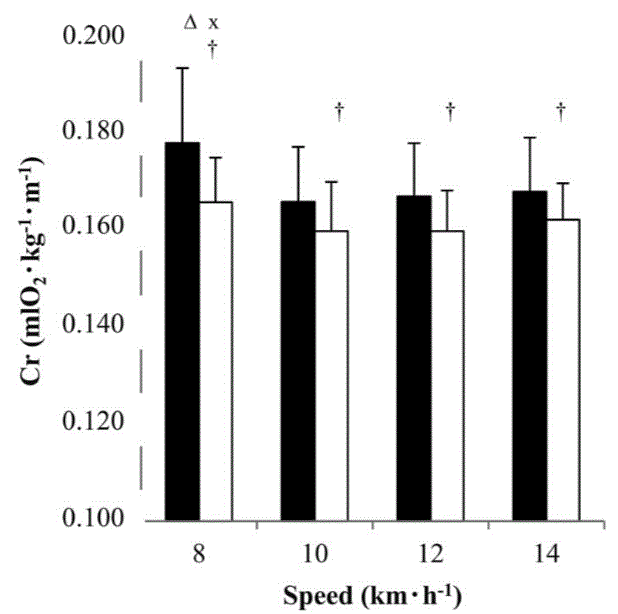
Figure 1.
Energy cost of running (Cr) as a function of running speed in the experimental group before (PRE - black bars) and after (POST - white bars) the experimental training period. Mean values and standard deviation. † - values significantly different between PRE and POST.
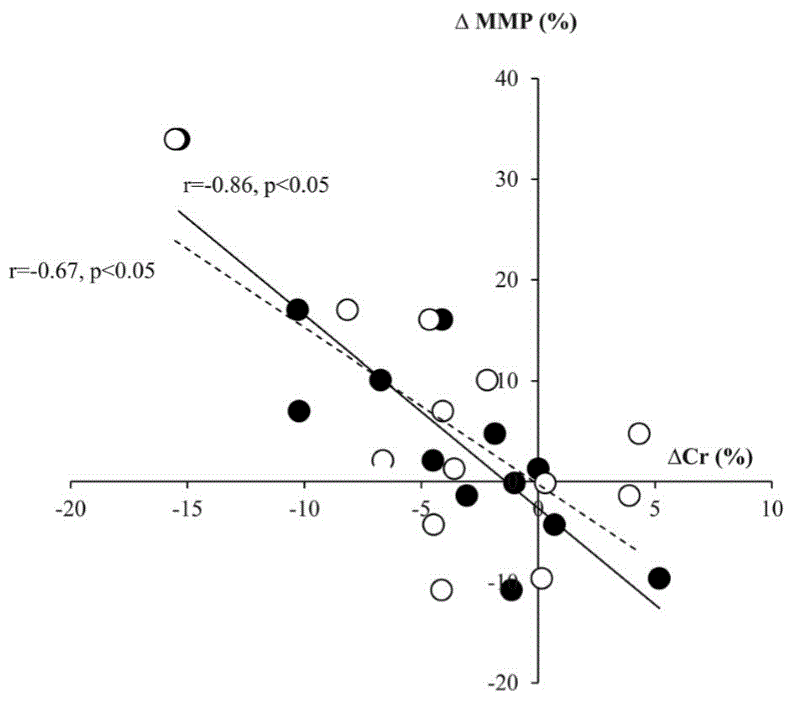
Figure 2.
Relationship between changes in energy cost of running (ΔCr, %) and maximal muscle power (ΔMMP, %) in the experimental group when running at 10 km/h (white circles) and 12 km/h (black circles).
Source:
Effects of strength, explosive and plyometric training on energy cost of running in ultra-endurance athletes.
Nicola Giovanelli, Paolo Taboga, Enrico Rejc & Stefano Lazzer
European Journal of Sport Science (2017),
DOI: 10.1080/17461391.2017.1305454