

 616281181



What is Dry Needling
Dry needling (DN) is an invasive technique used by physiotherapists that uses a thin threaded needle to penetrate the skin and stimulate underlying musculo-fascial trigger points (TrPs), muscle tissue to treat neuromusculoskeletal pain and movement disorders. Unlike wet needling, where needles with a hole are used to administer, for example, corticosteroids, anesthetics or other agents, dry needling involves the insertion of thin needles, used in acupuncture, without injection.
How is dry needling different from acupuncture?
Actually everything, except that we use needles,” explains Rehasport physiotherapist Slawomir Danaj. The main difference lies in the concept of work. The basis for acupuncture is Chinese medicine, with its theories of energy flow through meridians. Needles are inserted into points along the course of these meridians to normalize the flow of energy. Dry needling, on the other hand, uses physiological reactions and anatomical topography (needles are inserted into specific, identifiable structures) as the theoretical basis for its action.
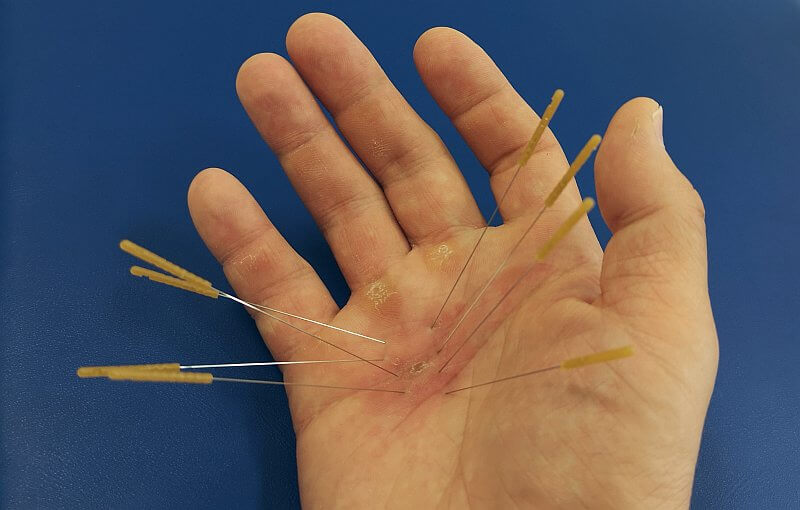
Trigger points
Trigger points are stiff, hard areas of excessive tenderness in a tense skeletal muscle band that produce painful symptoms. They can be active - causing pain spontaneously without exerting pressure on the muscles, or latent - not causing pain spontaneously, but being sensitive to palpation (touch). Among the causes of trigger points, the most common are: excessive strain on muscle structures, previous trauma, degenerative changes, surgery or diseases of internal organs. In addition to the characteristic complaints of pain, trigger points can cause a feeling of stiffness, reduced mobility and flexibility, as well as muscle weakness, muscle imbalance, and impaired motor control.
Mechanism of action of dry needling
At the Rehasport clinic, explains physiotherapist Bartosz Kiedrowski, we apply dry needling to the muscle belly and to localized trigger points in a given muscle. It is important that the irritation of a particular trigger point reflects the patient's complaints. The procedure itself, that is, this insertion of the needle, is already the final stage, which is preceded by an interview and in-depth diagnostics. The idea is to use dry needling, with each treatment using as few punctures as possible, while achieving the greatest possible effectiveness. I can say from experience that muscle relaxation with needling is “deeper” and more permanent than relaxation with manual therapy. Large blood vessels and nerves are bypassed here. It is important to remember that this is a relaxing procedure that provides the patient with relief from existing pain. However, dry needling is worth combining with active therapy, or the patient's self-therapy or exercise, to fully eliminate the problem and consolidate the treatment effect.
Possible side effects
Using dry needling, when a needle is inserted into a trigger point, it is expected to cause the discomfort the patient came in with. After the procedure, the area in question is often sore. Despite the relaxing effect, the patient may feel tension in the area. This post-treatment condition can last up to 48 hours. On the other hand, it is not a bad thing and you can undertake physical activity after the procedure. In addition, there may be small hematomas at the site of needling, muscle pain lasting 1-4 days and 1-2 days of hypersensitivity.
Contraindications to dry needling
- infection
- tumors
- skin lesions and open wounds
- severe atherosclerosis
- aneurysm
- sensory disorders
- pregnancy (doctor's approval needed)
- epilepsy
- needlephobia
What are the indications for dry needling?
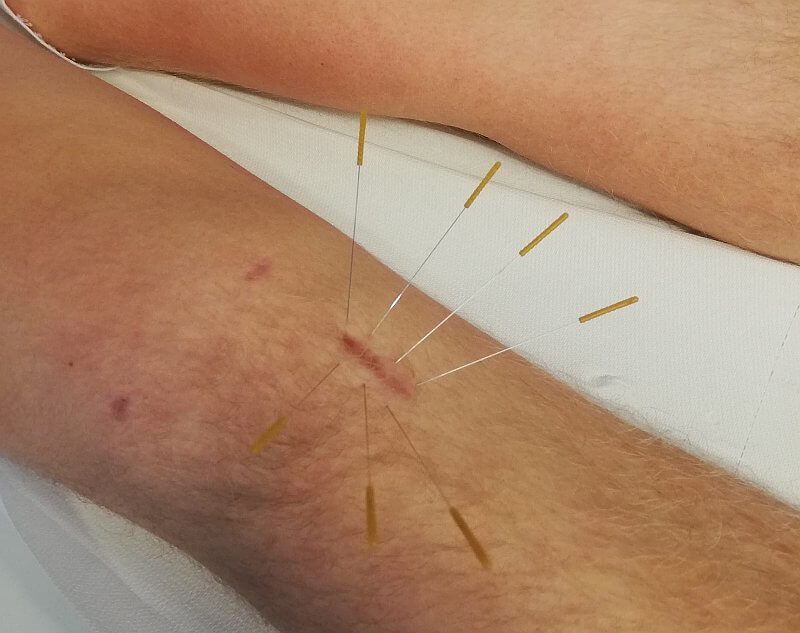
Indications for dry needling, explains Rehasport physiotherapist Bartosz Kiedrowski, are all kinds of strains such as shoulder pain due to tight muscles, Achilles pain with a lot of tight calf, “runner's knee”, “tennis elbow”, pain in the gluteal muscle area, lower back or neck pain. Dry needling is used wherever there are strains and the big problem is a tight muscle.
Is dry needling painful and how long does such a treatment last?
The duration of a single dry needling treatment depends on the number of trigger points being treated. It also depends on what kind of problem the patient comes in with and whether this is the first treatment or a subsequent one. People having first contact with needles are often afraid of pain. Before the procedure,” explains Rehasport physiotherapist Bartosz Kiedrowski, ”I try to explain all the pros and cons, inform about possible complications. Not to frighten, but to inform, so that the decision is up to the patient, who should be aware that at any time he can give information about discontinuing the procedure. Dry needling is often less painful than working the trigger points with the thumbs or elbow.