

 616281181


Rehabilitation of pregnant women
Physical activity for pregnant women has become particularly popular in recent years. In most fitness clubs you can find classes dedicated to pregnant women. Given the benefits of exercise, if there are no contraindications to it, it should not be neglected by pregnant women either. During the visit, the attending physician should inform the patient of the absence or presence of contraindications to exercise, which include:
- pregnancy-induced hypertension,
- shortening of the cervix in the early weeks of pregnancy,
- heart disease, or severe anemia.
What are the benefits of rehabilitation during pregnancy?
Properly selected and regularly performed exercises reduce pain and improve well-being. The most significant benefits of physical activity for pregnant women include:
- reducing spinal pain,
- improving the functioning of the respiratory and circulatory systems,
- muscle strengthening,
- control of weight during pregnancy and faster return to shape after delivery,
- reduction of skin stretch marks,
- increased blood flow, which positively affects fetal development and the course of pregnancy,
- improving mood by reducing anxiety, stress, having a calming effect and making it easier to fall asleep,
- better coping with the exertion of labor.
Pregnancy-related pain complaints
The decision to plan for motherhood provides an opportunity to lead a healthy lifestyle at an earlier stage, and consequently prepare the body for the greater burden of pregnancy and minimize overload problems. Significant changes affect the cardiovascular system: heart rate, circulating blood volume), respiratory system, musculoskeletal system (posture, body weight). These burdens lead to a decrease in the comfort of life for women. The most common problems faced by pregnant women include lumbar spine pain, pain in the sacroiliac joint, pain in the pubic symphysis, incontinence, sciatica, rectus abdominis muscle diastasis and swelling of the lower extremities. These problems can be remedied or minimized by properly selected pregnant women's health training by a physiotherapist.

Physical activity during pregnancy
An important rule is not to undertake physical activities that were not practiced before pregnancy, such as running, as the body is not accustomed to it, and is still under additional strain. Exercises dedicated to pregnant women should serve to improve the physical condition of the musculoskeletal system and the respiratory system. Training should be selected individually, as factors affecting its planning are: the degree of physical activity before pregnancy, the stage of pregnancy (the optimal time to start training is the second trimester, when nausea passes and the baby is not yet large in size), well-being, comorbidities, time disposition, economic aspect or family support. When exercising, attention should be paid to regularity, the ability to perform exercises correctly, awareness of the goal and correct loading.
Women training during pregnancy should pay special attention to a couple of aspects such as:
- The temperature of the room in which they train. It should not be too high, as pregnant women produce more heat, and exercise increases it further. Also remember to properly hydrate the body, which improves thermoregulation.
- During pregnancy, the demand for nutrients increases, so a balanced diet is very important. During the second and third trimesters, caloric requirements increase by about 300 kcal per day.
- During pregnancy, the heart rate increases. The recommended heart rate for endurance exercise is 120-140 beats per minute.
- Exercises with sudden changes in position, which can contribute to the collapse of the pregnant woman, are contraindicated, and contact sports, team games (basketball, handball) and sports with high shocks (skiing, skating, horseback riding) should also be avoided.
Because of the higher oxygen demand, it is advised to avoid sports - At high altitudes above sea level (above about 1,000 meters above sea level), which cause an increase in oxygen demand (climbing, walking at altitude)
- Swimming and water aerobics also have a positive effect. However, it is important to remember that the temperature of the water during hydrotherapy should not exceed 35 degrees C, and during swimming 31 degrees C.
Physical activities especially recommended for pregnant women are Nordic walking, walking, swimming, aquaerobics, yoga and Pilates for pregnant women. As mentioned earlier, a woman's physical activity before pregnancy is a very important factor. If a woman exercised a lot before pregnancy, and the workout is well tolerated by her, it can be extended up to 60 minutes. Women who had a sedentary lifestyle before pregnancy should initially exercise for about 15 minutes several times a week, gradually increasing the exercise time to 30-45 minutes.
The main rule of exercise at the gym, among others, is to work with smaller loads. For the upper limbs, this is 1-2 kg, and the lower limbs 5-10 kg. In addition, you should take more frequent breaks between exercises. The workout should last about 45 minutes and consist of a 15-minute warm-up, 15 minutes of general conditioning exercises and 15 minutes of relaxation. A particularly recommended position for exercise is the sit-up, which facilitates the diaphragm and reduces overstretching of the abdominal muscles. Exercises should not strongly engage the abdominal pressor. The following are examples of exercises that can be used during training.
Sample exercises for pregnant women
Supported kneeling. Hands under the shoulders, knees and feet at hip width. Spine in a neutral position. Raise the limb as far as possible to the line of the spine. For the first and second trimester, the opposite upper limb and lower limb can be lifted alternately, if the woman is able to keep her torso still.
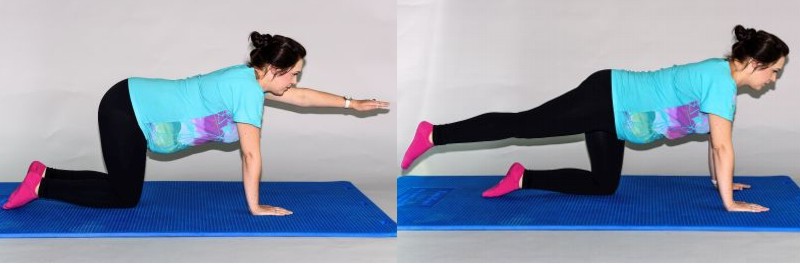
- Stepping out, the same number of repetitions for both legs. The spine in a neutral position, the knee joint of the excursion limb should not deviate inward.
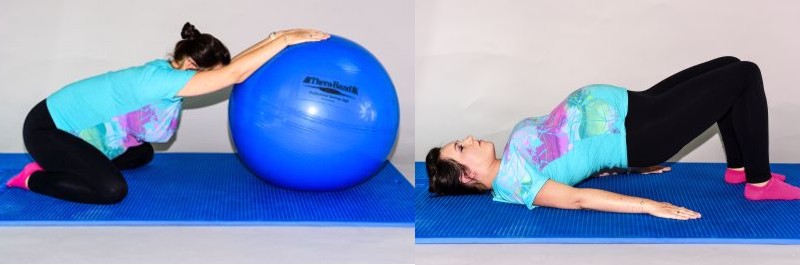
- Lower limbs positioned at hip width. Pelvic lift upward.
- Sitting on a fitness ball, perform forward, backward, side-to-side pelvic movements and circles.
- Lower limbs set at hip width, roller at the level of the lumbar spine. Bending and straightening the legs - rolling the back extensor muscle.
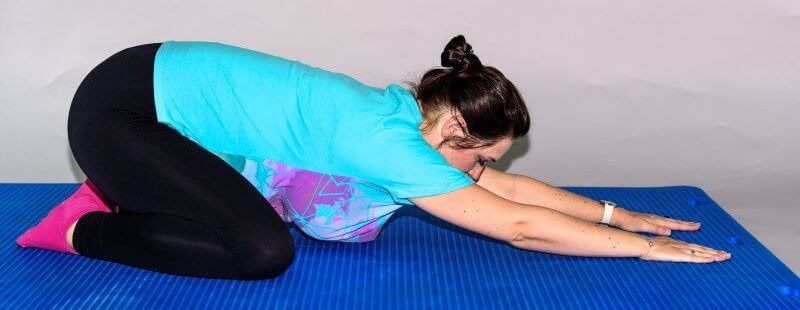
- Japanese bow. Sit on the heels, if the abdomen in a woman is large, position the knees wider to make room for the abdomen.
When exercising, pregnant women should remember not to lead to increasing feelings of fatigue, weakness, shortness of breath or dizziness. Indications for discontinuing exercise and going to a doctor for consultation according to the Canadian Guideline for Physical Activity Throughout Pregnancy are: constant, worsening shortness of breath that does not subside at rest, severe chest pain, regular and painful uterine contractions, vaginal bleeding, continuous loss of vaginal fluids that may indicate fetal waters, constant dizziness that does not pass at rest. In situations where a woman is experiencing pregnancy-related discomfort, this may limit her physical activity or eliminate it altogether.
To assist in the return to training, physiotherapists who specialize in pregnancy therapy come to the rescue. During the visit, the physiotherapist conducts a thorough interview with the woman, which involves asking insightful questions including the patient's ailments, co-morbidities, her level of physical activity, and expectations after therapy. She then proceeds with a physical examination, which allows the best possible diagnosis of the patient's condition. After gathering all the information, the physiotherapist can plan therapy to help the patient return to physical activity, or modify her training by, among other things, eliminating exercises that put too much strain on the abdominal compression.
What is physiotherapy for pregnant women based on?
- Manual therapy (fascial therapy, trigger points).
- Breathing exercises (learning to properly activate the breathing pathways) [6].
- Postural correction (modifying posture by activating postural muscles and eliminating certain lifestyle habits) [7].
- Exercises to strengthen weakened muscle parts.
- Specialized urogynecological therapy (e.g., for urinary incontinence, lumbar spine pain, or lowering of organs). - Kinesiology Taping (applications especially useful during pregnancy are: muscle support, stabilization and reduction of spinal pain, swelling).
- Related articles: urogynecological rehabilitation.
Bibliography:
- G. A. P.-S. J. K. M. Fraś M., „Styl życia kobiet w ciąży,” Hygeia Public Health, pp. 412- 417, 2012.
- S. M. M. W. i. w. Ćwiek D, „Analiza aktywności fizycznej podejmowanej przez kobiety w czasie ciąży,” Perinatologia, Neonatologia i Ginekologia, pp. 51-54, 2012.
- K. B. P. A. i. w. Gałązka I, „Aktywność fizyczna kobiet w ciąży – czynniki wpływające na podejmowanie lub ograniczenie wysiłku fizycznego,” ZDROWIE DOBROSTAN , 2013.
- T. A. Ć. D. Torbe D, „Nowa Medycyna,” Aktywność fizyczna kobiet w ciąży o fizjologicznym przebiegu, pp. 174-179, 2013.
- M. M.F, D. M.H i R. S. i. wsp., „2019 Canadian guideline for physical activity throughout pregnancy,” Br J Sports Med, pp. 1339-1346, 2019.
- A. Kaczmarek, „Zaburzenie wzorca oddechowego i jego możliwe konsekwencje,” Praktyczna fizjoterapia & rehabilitacja, pp. 38-43, grudzień 2016.
- A. Miksza, N. Smolarek, K. Chmaj-Wierzchowska i L. Zgrzeba, „Dolegliwości bólowe okolicy lędźwiowo-krzyżowej u kobiet w ciąży,” Polski Przegląd Nauk o Zdrowiu, pp. 115-123, 2017.