

 616281181


How to stay healthy in old age?
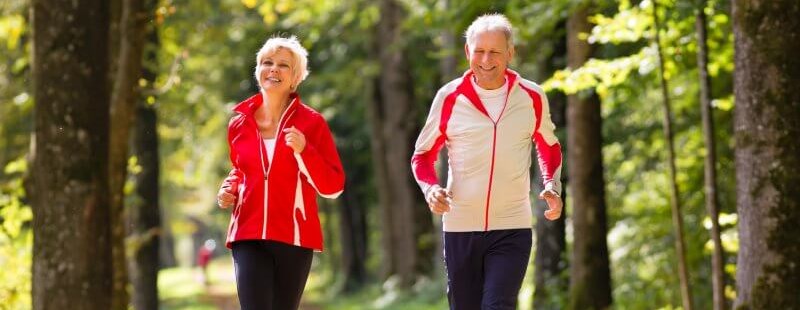
Among the main factors for maintaining health in old age are physical activity, limiting addictions, continuing education, active participation in social life, maintaining family contacts, and preventing loneliness. It is not without reason that physical activity is at the top of this list, as it is one of the most important factors in counteracting health loss in the elderly and extending the period of fitness. It affects the proper functioning of the cardiovascular and respiratory systems, increases muscle strength and joint mobility, and plays an important role in the prevention and treatment of osteoporosis.
Unfortunately, most elderly people show a marked decline in physical activity, which is limited to daily living activities. The aging process progresses in all systems of the body, but in everyone it proceeds at a different rate. With aging, a person's biological potential decreases, manifesting itself in reduced circulatory capacity, range of motion and muscle strength. This can lead to difficulty performing the simplest household chores. Movement slows down the aging process, inhibits the development of various diseases: hypertension, osteoporosis, diabetes, as well as widespread obesity. Regular exercise, preferably under the guidance of a qualified physiotherapist in a special program - Rehabilitation of the elderly, improves physical fitness, definitely improving the quality of life of the elderly.
Active life 60+
The aging process is associated with many changes, such as a decrease in lean body mass (including muscle atrophy), an increase in the percentage of body fat, a decrease in the elasticity of muscles, ligaments and tendons. However, studies show that even in old age it is possible to increase muscle mass and strength under the influence of resistance training (such as gym exercises). This nature of training is a safe method of improving muscle strength, being an ideal complement to aerobic (aerobic) physical activity such as Nordic Walking.
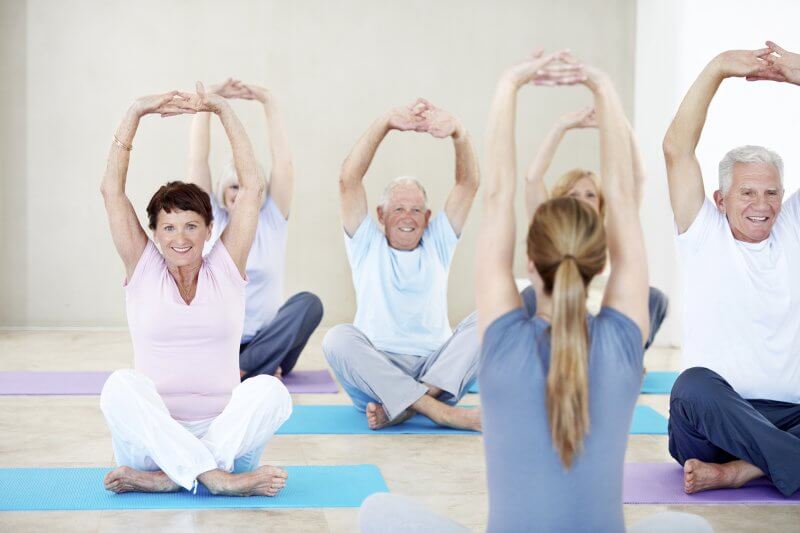
The choice of physical activity at age 60+ is individual and depends on a number of factors, including health and fitness level. In most cases, it should include the following exercises: endurance, strength and stretching, and should take place at least two to three times a week for about 30 minutes at an individually adjusted intensity. Each time, activities should begin with a short warm-up. In physical activity for the elderly, one should move from easier (already familiar) exercises, gradually moving to more difficult (new or more complicated) ones. Physical exertion will help maintain lifelong fitness, maintain health, independence and a good quality of life.
Physical fitness is also about safety
Good physical fitness at age 60+ is not only a better quality of life, it is above all safety. Regular physical exercise under the guidance of a qualified physiotherapist can have an impact on reducing the risk of falls in the elderly. This is a very important and complex issue, because as we age, the likelihood of falling increases significantly. As statistics show, in people over 80, one in two seniors is at risk of falling.
Physiological factors associated with the aging process are mainly responsible for this. Muscles become weaker and less flexible. Body posture becomes more stooped with the center of gravity shifted forward. With age, the functionality of the sensory organs: vision, hearing, balance and deep sensation, which determine postural stability, weakens. All this makes it difficult for the elderly to maintain balance, and on top of this it is more difficult to react quickly to various external factors (slippery ground, the sudden appearance of an obstacle).
Sense of balance - an indicator of health and life expectancy!
Falls among seniors are a major cause of injury and can have very dangerous consequences like soft tissue injuries, hematomas and even concussions. However, much more dangerous at this age are falls that end in broken bones - including a fracture of the femoral epiphysis. Treatment of this type of injury is complicated and lengthy, and the aftermath can be a fear of another fall. Such a person limits the performance of previous life activities, leads a more sedentary lifestyle, limiting going out of the house. This has the obvious effect of causing a loss of strength and weakening of the whole body.
However, this can be counteracted by choosing a program - Rehabilitation of the elderly. It is best to consult a qualified physiotherapist who can help restore physical fitness and help you regain control of your body. At the Rehasport clinic, you can have a specialized consultation with a physiotherapist who will professionally assess your individual risk of falling and give you specialized exercises to do at home.
Home test: if you are unable to stand stably on 1 leg for more than 10 seconds, the risk of falling in your case is high. You should consider a physiotherapy consultation in this situation!
Physical activity can also be taken care of at home. Below are examples of exercises for rehabilitation of the elderly. They are aimed at general improvement, muscle strengthening, coordination and balance training. Exercises are to be done accurately, the quality of their execution is important. For example, if you are after an injury, surgery, have pain, are being treated for chronic diseases such as hypertension, other cardiovascular, pulmonary, etc., consult your doctor and physiotherapist to diagnose - stabilize a possible disease or condition and select an activity that is safe and effective for you.
Rehabilitation of the elderly - warm-up
Can be performed sitting or standing
- circulating the wrists - 15 times each way,
- bending and straightening at the elbow joint - 15 times for each hand,
- lifting the arms (forward facing) 15 times,
- flexion and extension of the foot (ankle joint) 20 times,
- bending and straightening at the knee joint 20 times,
- circulation of the hips (while standing) 20 times(10 to each side),
- quiet rotation of the head to the right, return to the center, rotation to the left and return 3-5 times,
- arms crossed on the chest, abdomen tight, rotation of the trunk to the right and left 3-5 times.
Rehabilitation of the elderly - the main part
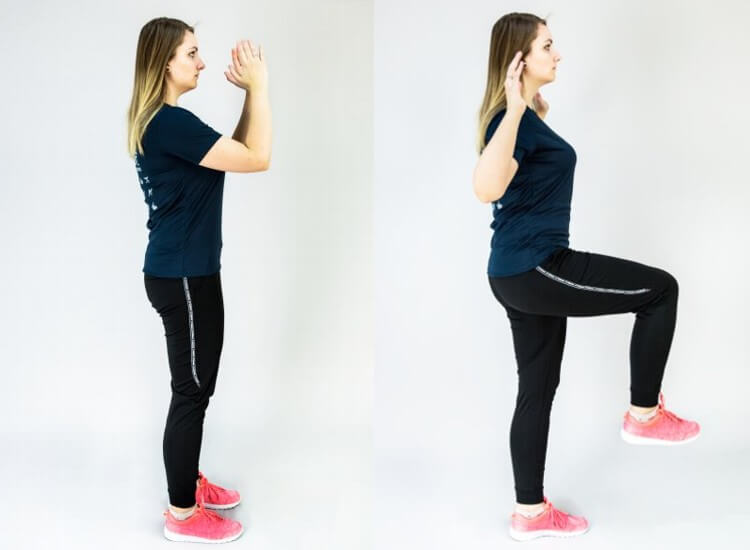
Stand straight, look in front of you, abdomen tight, arms bent in front of you. Perform alternating lifts of the bent leg to the horizontal with the simultaneous visit of the arms to the side, pushing out the chest. Lift the right leg and bring the arms to the side, return, lift the left leg bringing the arms to the side. Repeat the movement 10 times each in 3 series. After each series, rest a moment, 3 calm breaths.
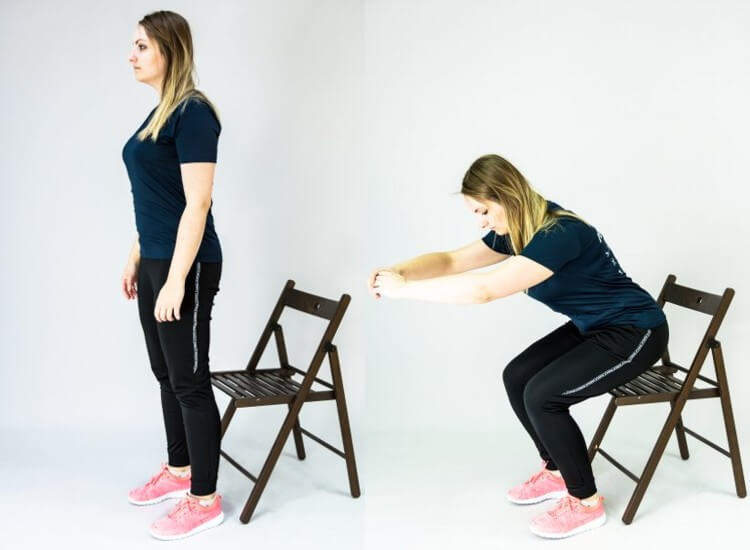
Stand with your back in front of a chair. Position your legs at hip width. Tighten your abdomen and buttocks. Perform a slow approach of the buttocks to the chair until you sit down and return to standing. It's important to keep your abdomen taut and your spine straight (don't arch it) and don't extend your knee line in front of your toes. Sit very slowly and lightly on a chair, return more vigorously without supporting yourself with your arms, tensing your buttocks tightly. Repeat 8 times in 3 series.
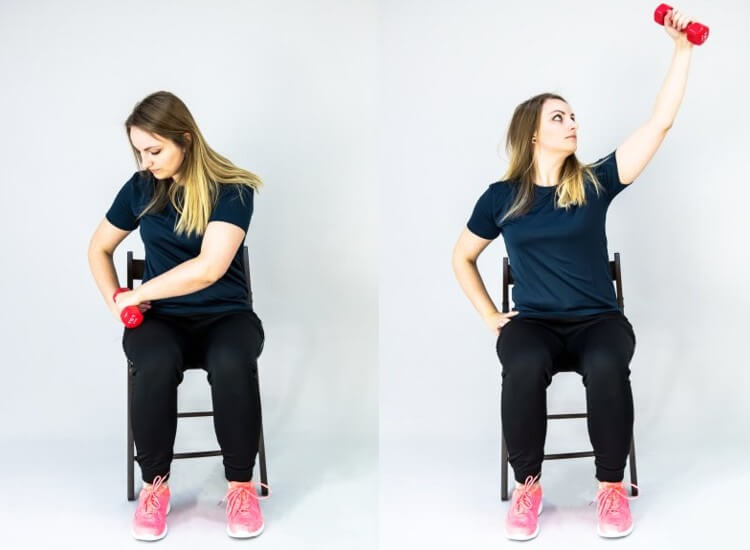
Take a 0.5-1 kg weight, possibly a half-liter bottle of water, and sit on a chair without leaning back, legs resting on the floor, knees bent to 90 degrees. Stomach tight, stable position.
Perform adduction and inversion of the arm diagonally with head movement. Bring the right hand with the weight to the left hip. Then guide the movement of the hand diagonally upward in the
right side and return to the hip. Perform the movement only with the arm and head (look behind the hand movement), the whole torso stationary. After completing the series, change sides. Repeat 8 times for each arm in 3 series.
Rehabilitation of the elderly - stretching
In this part, you should feel a slight stretch, without making your muscles feel overstretched.
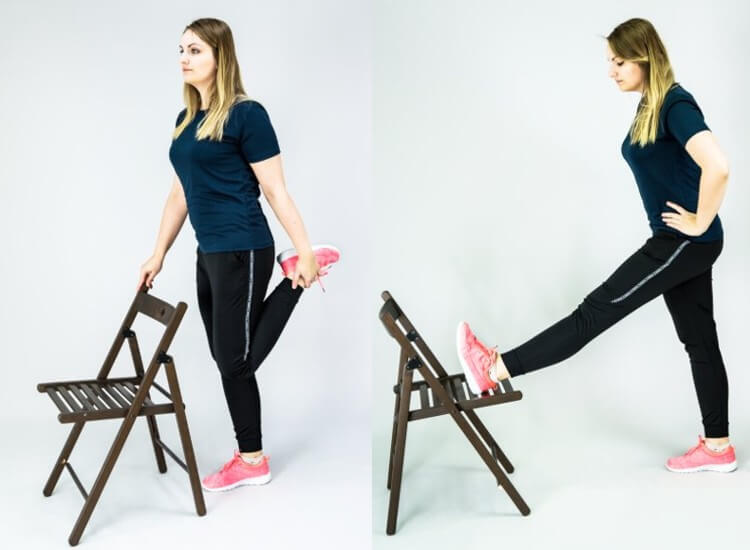
- Grab a chair with one hand, and with the other draw your leg towards your buttock; tighten your abdomen and buttocks; hold in a position of gently stretching the front of your thigh 10-30 seconds and change your leg.
- Place one leg straight on the chair, bring the toes of the foot towards you, tighten the abdomen and buttocks; with a gentle forward inclination of the trunk and pelvis, achieve a position of gentle stretching of the back of the thigh and hold for about 10-30 seconds; change the leg.
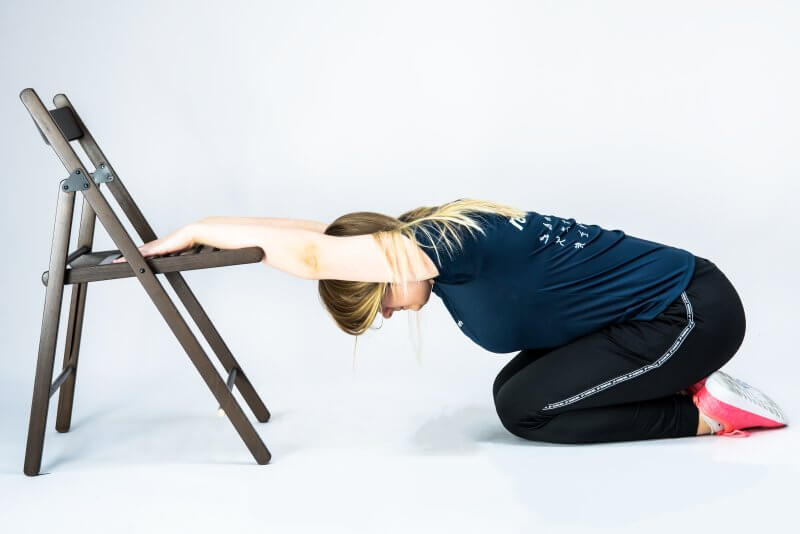
- Sit back on your heels, stretch your arms on the chair, make a trunk incline and stretch your arms as far forward as possible, hold for 10-30 seconds.
Active Senior Package
For the sake of your health, fitness and safety, it's a good idea to check if you are at risk. The Active Senior Package is aimed at people who are 60 years of age or older and want to expand their knowledge of their body's condition. The program consists of physical tests and a final consultation with a physiotherapist, who will develop an individualized exercise program. See a detailed desc.ription of the study.
Bibliography:
- Journal of the American Geriatrics Society - Geriatric Rehabilitation: State of the Art - Helen Hoenig MD, MPH, OT, Neil Nusbaum JD, MD, Kenneth Brummel-Smith MD - First published: April 27, 2015
- Gerontologia Polska - Influence of physical rehabilitation on psychophysical fitness of the elderly - Elżbieta Kozak-Szkopek, Krzysztof Galus
- Gerontologia Polska - Rehabilitation and the quality of life of the elderly - Grażyna Łój