

 616281181



What is a muscle tear?
A muscle tear is a partial disruption of muscle fibers, usually occurring during sports activities. This injury may involve one or more muscles and the tendons, which connect muscles to bones. Muscle tears typically result from excessive tension or strain on the muscle. This can happen when the muscle is overstretched or contracts suddenly, such as during intense physical exertion. Treatment for muscle tears depends on the severity of the injury; mild cases may require rest and rehabilitation, while severe cases might necessitate surgical intervention.
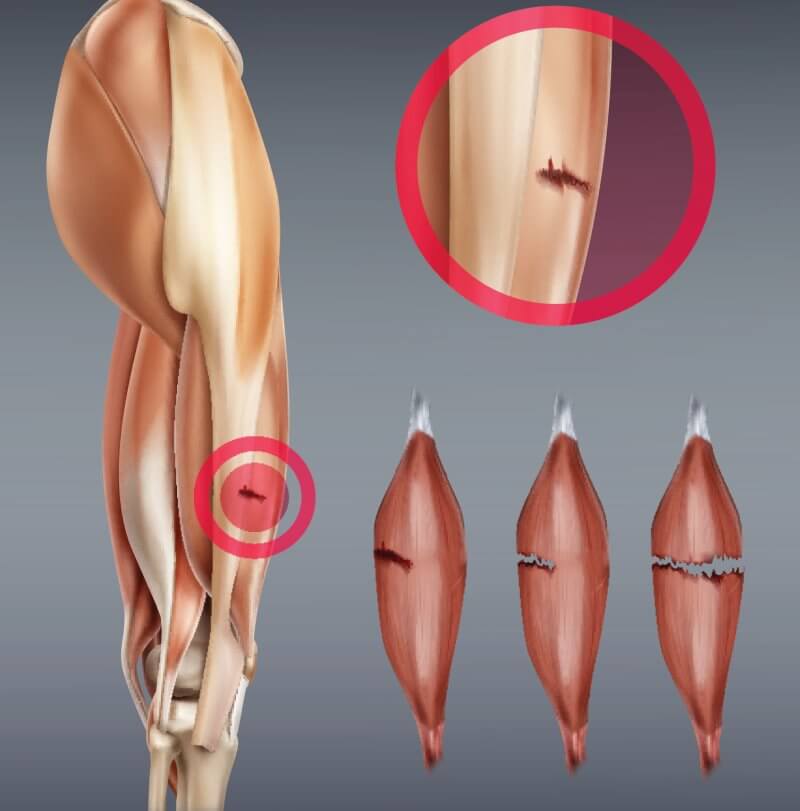
Three-Grade Classification of Muscle Injury
Muscle tears are often classified into three grades based on the severity of the injury:
- Grade I (strain):
In this case, the muscle is merely strained, with only a small number of muscle fibers damaged. Individuals with a Grade I tear typically experience pain, but the muscle retains full functionality. Swelling and bruising are minimal or absent. Recovery time usually ranges from a few days to a week. - Grade II (partial tear):
A greater number of muscle fibers are damaged, but the muscle is not completely ruptured. Swelling and bruising may be significant. Individuals with a Grade II tear typically experience pain during movement and have limited ability to use the affected muscle. Recovery may take several weeks to a few months, depending on the severity. - Grade III (complete rupture):
This is the most severe type of muscle tear, where the muscle is fully torn or detached from the tendon. Pain is intense, and using the affected muscle becomes impossible. Swelling and bruising are substantial. Treatment often requires surgical intervention, with recovery time generally spanning several months.
Symptoms of a Muscle Tear
Symptoms of a muscle tear vary based on the severity and location of the injury. Common signs include:
- Pain: Sharp, intense pain that may arise immediately or increase over time.
- Swelling: Fluid accumulation in the injured area causing visible swelling.
- Bruising: Damage to small blood vessels may result in hematomas.
- Muscle Weakness: Difficulty moving the affected body part.
- Sensation of a Snap or Pop: In some cases, the injury may be accompanied by an audible or felt snap.
Causes of Muscle Tears
Muscle tears are most commonly caused by a sudden, intense strain exceeding the muscle’s capacity. Common scenarios leading to muscle tears include:
- Excessive effort: Performing strenuous activities like heavy lifting or sprinting without adequate preparation.
- Sudden, uncontrolled movements: Twisting, jumping, running with direction changes, or abrupt stops.
- Blunt trauma: Such as falls, car accidents, or sports-related impacts.
- Overuse or fatigue: Repetitive motions over long periods or physical exhaustion.
- Additionally, conditions like diabetes, neurological disorders, and aging can increase the risk due to reduced muscle elasticity.
Complete Muscle Rupture
A complete muscle rupture (Grade III) is the most severe muscle injury, involving full separation of all muscle fibers and sometimes tendons. In such cases, the muscle cannot function normally, and the affected area may appear deformed, such as a "bunched-up" muscle. Surgical intervention is often required to repair the torn fibers and tendons, followed by a rehabilitation program to restore strength and mobility.
Does a Muscle Rupture Always Require Surgery?
Treatment depends on factors such as the severity of the injury, its location, and the patient's overall health. Less severe injuries or those involving non-critical muscles can sometimes be managed conservatively with rest, PRICE protocol (Protection, Rest, Ice, Compression, Elevation), pain relief, and physiotherapy.
Surgery is typically necessary for significant dysfunctions, such as complete ruptures of major muscles like the biceps or Achilles tendon. Decisions should be made in consultation with an orthopedic specialist.
Diagnosing Muscle Tears
Diagnosis begins with a detailed medical history and clinical examination. The physician evaluates:
- Range of motion, muscle strength, and pain sensitivity.
- Signs of swelling, bruising, deformity, or other anomalies.
Further diagnostic imaging, such as ultrasound or MRI, may be used to assess the extent of muscle and tendon damage. X-rays may also be helpful, particularly for muscle attachments in younger patients. Based on these findings, a treatment plan can be developed.
Treatment of Muscle Tears
Treatment depends on the grade and location of the tear, as well as the patient's general health. Key initial steps include:
- Rest: Avoiding activities that caused the injury.
- Ice application: For 15–20 minutes every few hours during the first 1–2 days to reduce swelling and pain.
- Compression and elevation: Using an elastic bandage and elevating the injured muscle above heart level to decrease swelling.
- Pain relief and anti-inflammatory medications may also help.
Rehabilitation becomes critical once the patient's condition improves. A physiotherapist will design an exercise program to restore strength and range of motion. Severe tears that cannot heal independently may require surgical intervention.
Surgery for Muscle Ruptures
In cases involving tendon attachment, surgery may involve reattaching the muscle to its original site. The procedure is usually performed under general or local anesthesia and is often straightforward. Rehabilitation starts cautiously after surgery, gradually increasing in intensity over weeks. A full return to sports is typically achievable with proper care.
Recovery Time After Surgery
Recovery depends on factors like the severity and location of the injury, the type of surgery, and the patient's overall health. Small tears may heal in weeks, while severe injuries can take months. A full return to intense physical activity may require 6–12 months. Strict adherence to post-operative care and physiotherapy is crucial to minimizing complications and ensuring recovery.
Prevention of Muscle Tears
Preventative strategies include:
- Warm-ups: Prepare muscles for activity with proper stretching and dynamic exercises.
Gradual progression: Avoid sudden increases in workout intensity. - Proper nutrition and hydration: Support muscle health with a balanced diet and adequate fluids.
- Correct technique: Ensure exercises are performed properly to avoid undue strain.
- Rest and recovery: Allow muscles time to recover after exertion.
- Appropriate equipment: Use suitable sports gear and footwear for adequate support.
- Developing a personalized prevention plan with a fitness coach or medical professional is recommended to address individual needs.
Bibliography:
- Muscle strain injuries - WE Garrett Jr - The American journal of sports medicine, 1996.
- Mueller-Wohlfahrt HW, Haensel L, Mithoefer K, Ekstrand J, English B, McNally S, Orchard J, van Dijk CN, Kerkhoffs GM, Schamasch P, Blottner D. Terminology and classification of muscle injuries in sport: the Munich consensus statement. British journal of sports medicine. 2013 Apr 1;47(6):342-50.
- Kneeland JP. MR imaging of muscle and tendon injury. Eur J Radiol. Nov 1997;25(3):198-208